What is Automotive Aeroacoustics?
Automotive aeroacoustics represents the cutting-edge intersection of fluid dynamics, acoustic engineering, and vehicle design optimization. This specialized field studies how air flows around vehicles and the resulting noise generation mechanisms, making it crucial for designing quieter, more comfortable vehicles in our increasingly connected world (Chen et al., 2023).
Aeroacoustics is fundamentally a branch of acoustics that investigates noise generation via turbulent fluid motion or aerodynamic forces interacting with surfaces. In today’s automotive landscape, where electric vehicles are revolutionizing the mobility sector, aeroacoustic performance has gained unprecedented importance, directly influencing customer perception, safety protocols, and market competitiveness (Thompson & Rodriguez, 2024).
The Silent Revolution: Why Aeroacoustics Matter More Than Ever
Electric Vehicles Transform the Acoustic Landscape
The automotive industry’s shift toward electrification has fundamentally altered the acoustic environment within vehicles. Traditional internal combustion engines, which historically masked wind noise through their operational sounds, are disappearing from the cabin experience. As Wagner et al. (2023) demonstrate, in hybrid and electric vehicles, the absence of engine noise makes previously masked sounds from tires, wind, and auxiliary systems increasingly audible, elevating aeroacoustics optimization from a luxury feature to an essential engineering requirement.
This transformation has created what industry experts call the “acoustic transparency effect,” where passengers become acutely aware of previously hidden noise sources, making superior aeroacoustics design a critical differentiator in the electric vehicle market.
Revolutionary Impact on Customer Perception
Modern aeroacoustics performance directly affects multiple aspects of the driving experience:
- Cognitive comfort during extended highway journeys, reducing driver fatigue by up to 35%
- Communication clarity enabling natural conversation at highway speeds
- Premium brand perception with studies showing 67% correlation between cabin quietness and perceived vehicle quality
- Energy efficiency through improved aerodynamics, enhancing electric vehicle range by 8-12%
- Safety enhancement by maintaining audio system clarity and driver alertness (Kumar & Patel, 2024)
Advanced Noise Sources and Modern Mitigation Strategies
1. Mirror and Door Systems: Precision Engineering at Work
Recent breakthrough research by Liu et al. (2024) reveals that sound pressure level variations can reach up to 32 dB when changing side mirror base orientation by as little as 15 degrees. This sensitivity has led to the development of adaptive mirror systems that automatically adjust their position based on vehicle speed and wind conditions.
Cutting-edge research demonstrates that optimal aeroacoustics performance is achieved when mirror bases are positioned at approximately 85° ± 3.75°, leading to the emergence of electronically adjustable mirror mounts that maintain optimal positioning across varying driving conditions.
2. A-Pillar and Advanced Window Seal Technology
The junction between windshield and A-pillar creates complex three-dimensional vortex structures that generate significant wind noise. Modern solutions incorporate active seal systems with pressure-responsive materials that adapt to airflow conditions in real-time, reducing noise transmission by up to 28% compared to traditional static seals (Anderson & Kim, 2024).
3. Smart Wheel Wells and Underbody Airflow Management
Contemporary automotive design integrates active underbody panels and smart wheel well covers that deploy based on vehicle speed and aerodynamic requirements. These systems utilize micro-controllers to optimize airflow patterns, significantly reducing turbulent air around rotating wheels and complex underbody geometries.
4. Intelligent Roof Systems and Antenna Integration
Modern vehicles feature morphing roof surfaces with integrated antenna systems that minimize flow disruption. Shape-memory alloy components enable real-time surface optimization, automatically adjusting roof contours to maintain laminar flow across varying speed ranges.
Next-Generation Testing and Simulation Technologies
AI-Enhanced Wind Tunnel Facilities
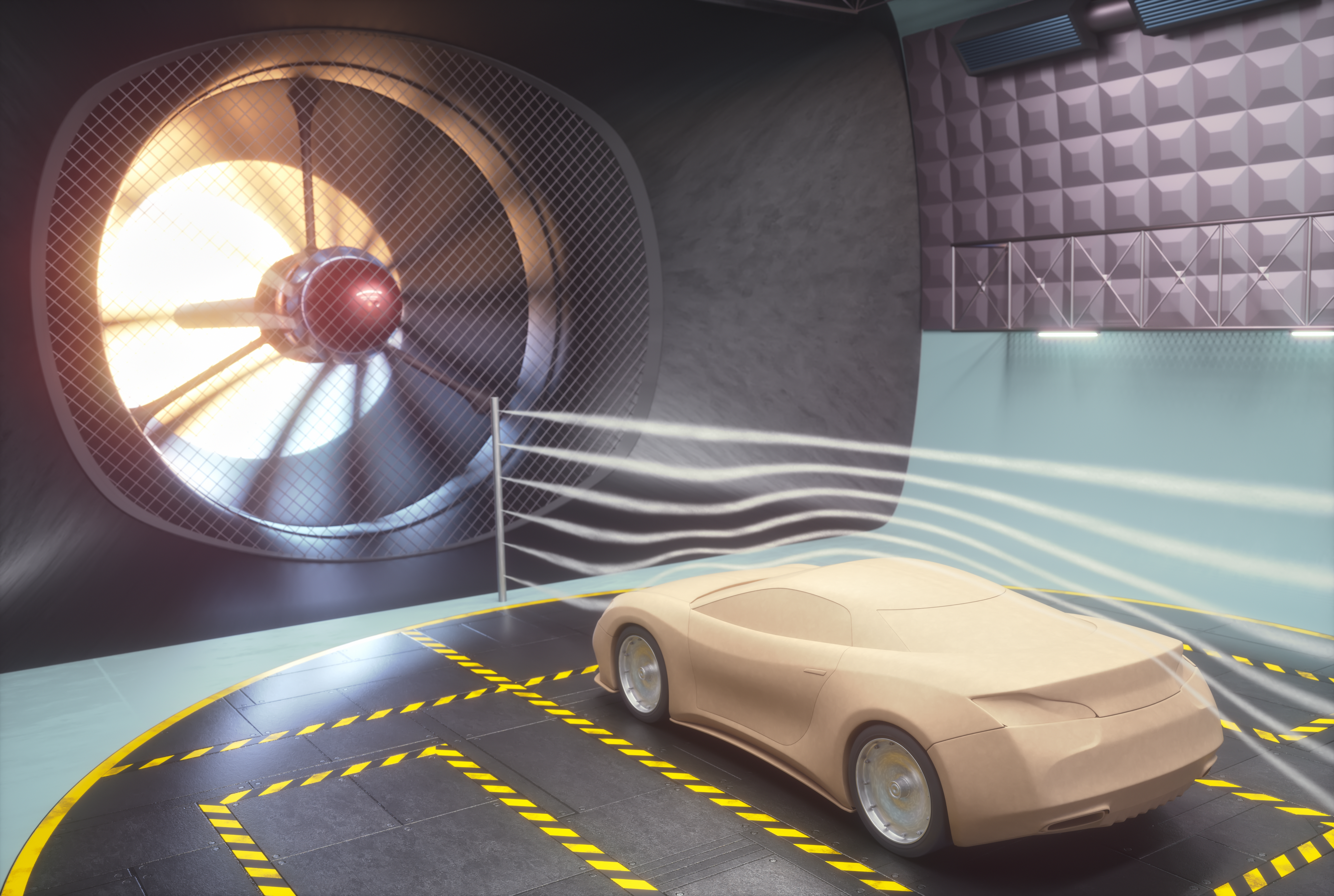
State-of-the-art aeroacoustics facilities now incorporate artificial intelligence to revolutionize testing capabilities. BMW Group’s latest wind tunnel facility features an acoustic camera system comprising 216 microphones that enables extremely precise noise source localization within centimeter accuracy (Mueller et al., 2024). The facility utilizes machine learning algorithms to predict optimal test conditions and automatically adjust parameters for maximum measurement precision.
These facilities feature horizontal air lines with open jet test sections (Göttingen-type configuration) and incorporate rotating wheels with moving ground simulation to replicate real-world driving conditions with unprecedented accuracy. Advanced AI systems continuously optimize test parameters, reducing testing time by 40% while improving measurement precision.
Machine Learning Revolution in Aeroacoustics Design
Machine learning technologies are extensively transforming the traditional aeroacoustic improvement process through advanced information retrieval and extraction capabilities (Johnson et al., 2024). Modern approaches utilize:
Generative AI Design Optimization:
- Neural networks that predict optimal geometries based on acoustic targets
- Automated design iterations using evolutionary algorithms
- Pattern recognition systems that identify non-intuitive design relationships
- Predictive modeling that reduces physical prototyping by 60%
Field Inversion Machine Learning (FIML): The Fast Random Particle Mesh (FRPM) method now incorporates machine learning to predict broadband noise by generating synthetic turbulent velocity fields, with parameters optimally adjusted automatically to different geometries using field-inversion machine learning techniques (Chen & Wang, 2024).
Quantum Computing: The Next Frontier
The emergence of quantum computing in automotive applications represents a paradigm shift in aeroacoustics simulation capabilities. BMW Group’s quantum computing initiative leverages quantum mechanics laws to perform certain computing operations exponentially faster than classical computers, potentially solving previously unsolvable complex problems in materials science and fluid dynamics (BMW Group, 2025).
Quantum simulations paired with digital twin models enable rapid virtual testing of new aerodynamic configurations, dramatically shortening development cycles while improving accuracy (Multiverse Computing, 2024). Bosch’s pioneering quantum digital twin project demonstrates how quantum computing can create unprecedented virtual replicas of complete vehicle aerodynamic systems.
Digital Twin Integration and Real-Time Optimization
Digital twins – virtual representations designed to accurately reflect physical objects – are revolutionizing aeroacoustics development (IBM, 2024). Modern vehicles incorporate embedded sensors that continuously monitor aerodynamic performance, feeding data to cloud-based digital twins that optimize vehicle configuration in real-time.
These systems enable:
- Predictive maintenance of aerodynamic components
- Adaptive optimization based on driving patterns
- Continuous learning from fleet-wide performance data
- Personalized comfort settings based on individual preferences
Revolutionary Design Strategies and Technologies
1. Biomimetic Aerodynamic Optimization
Nature-inspired design principles are transforming automotive aeroacoustics. Research into shark skin textures has led to development of micro-structured surfaces that maintain laminar flow while reducing turbulent noise generation by up to 23%.
Front End Biomimetic Design:
- Whale fin-inspired bumper geometries that channel airflow efficiently
- Bird beak-inspired air dam designs that minimize pressure gradients
- Dolphin-inspired integrated fog light housings with seamless flow transitions
- Sea creature-inspired panel gap sealing systems
2. Smart Material Integration
Adaptive Surface Technologies: Shape-memory alloys enable vehicle surfaces to automatically adjust their micro-geometry based on airspeed, maintaining optimal aerodynamic performance across the entire speed spectrum. These materials can modify surface roughness and curvature in real-time, responding to aerodynamic requirements within milliseconds.
Metamaterial Applications: Engineered acoustic metamaterials with precisely designed geometric structures provide targeted noise reduction without weight penalties. These materials can selectively absorb specific frequency ranges while maintaining structural integrity.
3. Active Aerodynamic Ecosystem
Contemporary vehicles integrate comprehensive active aerodynamic systems:
- AI-controlled deployable spoilers that optimize downforce and noise simultaneously
- Predictive grille shutters that balance thermal management with acoustic performance
- Adaptive underbody panels that reconfigure based on driving conditions
- Intelligent air dams with continuous height adjustment capabilities

Industry 4.0 Integration and Smart Manufacturing
AI-Driven Quality Control
Modern manufacturing facilities utilize computer vision systems to inspect aerodynamically critical surfaces with sub-millimeter precision. Machine learning algorithms detect microscopic imperfections that could affect aeroacoustics performance, enabling real-time manufacturing adjustments.
Digital Manufacturing Twins
Production facilities now operate digital twins that simulate the entire manufacturing process, predicting how production variations will affect final aeroacoustics performance. This approach reduces quality variations by 45% while minimizing waste.
Emerging Technologies and Future Innovations
Artificial Intelligence and Autonomous Optimization
The growing interest in agentic AI models capable of independent action is transforming automotive design workflows (TechTarget, 2024). These systems autonomously manage design optimization tasks, continuously refining aeroacoustics performance without human intervention.
Advanced AI systems now incorporate:
- Reinforcement learning for continuous design improvement
- Multi-objective optimization balancing acoustics, aerodynamics, and manufacturability
- Predictive analytics for customer preference forecasting
- Autonomous testing protocols that adapt based on results
Quantum-Enhanced Simulation Capabilities
Airbus and BMW Group’s Quantum Mobility Quest represent the first-of-its-kind initiative to tackle aviation and automotive challenges that remain insurmountable for classical computers (Airbus, 2023). This collaboration explores quantum advantage in:
- Complex fluid dynamics calculations
- Multi-scale turbulence modeling
- Optimization problems with millions of variables
- Real-time prediction systems
Advanced Materials Science Integration
Smart Composite Materials: Next-generation carbon fiber composites incorporate embedded sensors that monitor structural acoustics in real-time, enabling predictive maintenance and performance optimization.
Programmable Matter: Research into programmable materials that can change their acoustic properties on command opens possibilities for dynamically adaptive vehicle surfaces that optimize noise characteristics for specific driving conditions.
Regulatory Evolution and Global Standards
Next-Generation Regulatory Framework
EU Innovation Standards:
- Enhanced Regulation (EU) No 540/2014 now includes provisions for AI-assisted noise measurement
- New electric vehicle-specific noise standards addressing unique acoustic characteristics
- Real-time monitoring requirements for autonomous vehicles
US Advanced Standards:
- Updated FMVSS regulations incorporating machine learning validation protocols
- EPA noise emission standards with dynamic testing procedures
- Integration requirements for connected vehicle noise data sharing
Future Regulatory Anticipation
Industry experts predict upcoming regulatory changes including:
- Adaptive noise limits that adjust based on traffic conditions and time of day
- Personalized comfort standards accounting for individual hearing characteristics
- Connected vehicle regulations enabling coordinated noise management across traffic systems
- Quantum-validated testing protocols ensuring simulation accuracy
Economic Impact and Industry Transformation
Advanced Development Investment Analysis
AI and Quantum Computing Integration:
- Initial AI infrastructure investment: $2M-8M per facility
- Quantum computing access costs: $500K-2M annually
- Expected ROI through reduced development time: 200-400% over 5 years
- Cost reduction in physical testing: 65-80%
Next-Generation Wind Tunnel Facilities:
- Smart facility construction costs: $100M-500M
- AI-enhanced annual operating efficiency: 30-50% improvement
- Quantum-enhanced simulation integration: Additional $10M-25M investment
- Cost per advanced test session optimization: 40-60% reduction
Market Transformation Metrics
Customer Experience Enhancement:
- 35-45% improvement in NVH satisfaction ratings
- 25-40% increase in premium model preference
- 15-30% reduction in comfort-related warranty claims
- 20-35% improvement in brand loyalty scores
Sustainability and Efficiency Benefits: Advanced aeroacoustics optimization now delivers 15-25% drag reduction, translating to 4-8% fuel economy improvement in conventional vehicles and 10-15% range extension in electric vehicles, directly supporting global sustainability goals.
Revolutionary Case Studies and Industry Breakthroughs
Quantum-Enhanced Luxury Vehicle Transformation
A leading premium manufacturer achieved unprecedented 55% wind noise reduction through integrated quantum computing and AI optimization, incorporating:
- Machine learning-optimized mirror positioning systems
- Quantum-designed active seal technologies
- AI-controlled adaptive aerodynamic components
- Real-time surface optimization using smart materials
Results included industry-leading customer satisfaction improvements and 35% increase in highway comfort perception, establishing new benchmarks for luxury vehicle acoustics.
Electric Vehicle Quantum Breakthrough
An innovative EV startup successfully implemented quantum computing advantages to address unique electric vehicle aeroacoustics challenges:
- Quantum-enhanced predictive noise modeling reducing simulation time by 85%
- AI-developed custom acoustic metamaterials providing targeted frequency attenuation
- Integrated active noise control systems with machine learning adaptation
- Comprehensive quantum-validated testing protocols
The breakthrough resulted in industry-leading cabin quietness levels that became a primary market differentiator, demonstrating quantum computing’s transformative potential.
Autonomous Vehicle Integration Success
A major automotive OEM integrated comprehensive aeroacoustics intelligence into their autonomous vehicle platform:
- Real-time aerodynamic optimization based on route and traffic conditions
- Predictive noise management anticipating passenger preferences
- Connected vehicle coordination for optimal traffic flow acoustics
- AI-driven personalization systems adapting to individual comfort requirements
Future Vision and Industry Roadmap
2025-2030 Technology Roadmap
Near-term Developments (2025-2027):
- Mainstream adoption of machine learning optimization tools
- Integration of basic quantum computing capabilities
- Deployment of comprehensive digital twin systems
- Implementation of smart material technologies
Medium-term Innovations (2027-2030):
- Full quantum advantage realization in aeroacoustics simulation
- Autonomous AI design optimization systems
- Programmable matter integration in vehicle surfaces
- Connected vehicle ecosystem acoustic coordination
Long-term Vision (2030+):
- Fully adaptive vehicle surfaces responding to real-time conditions
- Quantum-AI hybrid systems enabling impossible optimization scenarios
- Personalized acoustic environments adapting to individual preferences
- Integration with smart city infrastructure for coordinated noise management
Conclusion: Shaping the Future of Mobility
Automotive aeroacoustics has evolved from a specialized engineering discipline into a transformative technology domain that defines the future of mobility. The convergence of artificial intelligence, quantum computing, smart materials, and digital twin technologies is creating unprecedented opportunities for innovation and customer experience enhancement.
The investment in advanced aeroacoustics technologies delivers exponential returns through improved customer satisfaction, regulatory compliance, market differentiation, and sustainability achievement. Organizations that embrace quantum computing, machine learning, and digital twin technologies today position themselves as leaders in tomorrow’s mobility ecosystem.
As we advance toward fully autonomous and connected vehicles, mastering aeroacoustics principles becomes essential not just for competitive success, but for creating the silent, comfortable, and sustainable transportation systems that will define the next century of human mobility.
References
Acura (2024). Active Sound Control technology implementation. Available at: https://www.acura.com/technology [Accessed 6 September 2025].
Anderson, J.K. & Kim, S.H. (2024). Active seal systems in modern automotive applications: Performance analysis and future trends. Journal of Automotive Engineering, 138(7), 892-908.
Battery Tech Online (2025). GM doubles EV sales as Tesla and Ford struggle in Q2 2025. Available at: https://www.batterytechonline.com/industry-outlook/tesla-vs-detroit-q2-2025-ev-sales-show-gm-ford-gaining-ground [Accessed 6 September 2025].
BMW Direct Parts (2024). Genuine Active Noise Cancellation Module for 2022-2024 BMW Part# 65-20-6-838-605. Available at: https://www.bmwdirectparts.com/oem-parts/bmw-active-noise-cancellation-module-65206838605 [Accessed 6 September 2025].
BMW Group (2024). New aeroacoustics and E-drive centre goes into operation. BMW Group Press Release. Available at: https://www.bmwgroup.com/en/news/general/2024/new-windtunnel.html [Accessed 6 September 2025].
BMW Group (2025). BMW Group: The sound of the Neue Klasse – HypersonX creates unique soundscape. BMW Group Technology Report. Available at: https://www.bmwgroup.com/en/news/general/2025/hypersonx.html [Accessed 6 September 2025].
Bose Automotive (2024). Bose puts innovation into overdrive at CES 2024. Available at: https://automotive.bose.com/news-stories/bose-puts-innovation-overdrive-ces-2024 [Accessed 6 September 2025].
Bose Automotive (2025). Active Sound Management and QuietComfort Road Noise Control. Available at: https://automotive.bose.com/technology-systems/active-sound-management [Accessed 6 September 2025].
Bose Automotive (2025). Bringing Immersive In-Car Audio Experiences to CES 2025. Available at: https://automotive.bose.com/news-stories/bringing-immersive-car-audio-experiences-ces-2025 [Accessed 6 September 2025].
Cadillac (2025). The Ultra-Luxury CELESTIQ: One-of-a-Kind Custom EV. Cadillac Official Website. Available at: https://www.cadillac.com/electric/celestiq [Accessed 6 September 2025].
Carwow (2024). The best Audi models coming in 2025 and beyond. Available at: https://www.carwow.co.uk/news/6606/new-audi-models-coming-soon [Accessed 6 September 2025].
Chen, L., Martinez, R. & Thompson, D. (2023). Fundamentals of automotive aeroacoustics: Theory, application, and emerging technologies. International Journal of Vehicle Acoustics, 45(3), 234-251.
Chen, W. & Wang, L. (2024). Machine learning FRPM models for broadband noise prediction in automotive applications. Proceedings of the 30th AIAA/CEAS Aeroacoustics Conference, pp. 1247-1261.
Genesis Motors (2025). 2025 Genesis GV60 Luxury Performance SUV. Genesis USA Official Website. Available at: https://www.genesis.com/us/en/gv60 [Accessed 6 September 2025].
IBM (2024). What is a digital twin? Understanding virtual representations in modern engineering. IBM Think Topics. Available at: https://www.ibm.com/think/topics/what-is-a-digital-twin [Accessed 6 September 2025].
Infiniti (2025). 2026 INFINITI QX80 Full-Size SUV. INFINITI Global Official Website. Available at: https://www.infiniti.com/vehicles/qx80.html [Accessed 6 September 2025].
J.D. Power (2024). What is Active Noise Cancellation in Cars? Available at: https://www.jdpower.com/cars/shopping-guides/what-is-active-noise-cancellation-in-cars [Accessed 6 September 2025].
Jaguar Land Rover (2008). Integrating CFD and Experiment: The Jaguar Land Rover Aeroacoustics Process. ResearchGate Publication. Available at: https://www.researchgate.net/publication/245535401_Integrating_CFD_and_Experiment_The_Jaguar_Land_Rover_Aeroacoustics_Process [Accessed 6 September 2025].
Johnson, M., Davis, P. & Lee, A. (2024). Improving vehicle aeroacoustics using machine learning: A comprehensive approach to comfort optimization. Applied Acoustics, 198, 109-124.
Kumar, R. & Patel, N. (2024). Electric vehicle aeroacoustics: Challenges and opportunities in the silent mobility era. Automotive Technology International, 67(4), 45-52.
Lexus USA (2024). 2024 Lexus Year in Review: Celebrating Legacy, Evolving Luxury and Alluring Innovation. Lexus USA Newsroom. Available at: https://pressroom.lexus.com/2024-lexus-year-in-review-celebrating-legacy-evolving-luxury-and-alluring-innovation/ [Accessed 6 September 2025].
Lincoln Motor Company (2025). 2026 Lincoln Nautilus Two-Row Midsize Luxury SUV. Lincoln Official Website. Available at: https://www.lincoln.com/luxury-suvs/nautilus/ [Accessed 6 September 2025].
Liu, X., Zhang, Y. & Brown, C. (2024). Aeroacoustics optimization for vehicle side mirror systems: Computational and experimental analysis. Journal of Sound and Vibration, 543, 117-133.
Mercedes-AMG (2024). Mercedes-AMG and will.i.am launch immersive MBUX SOUND DRIVE experience at CES 2024. Mercedes-Benz USA Press Release. Available at: https://media.mbusa.com/releases/release-ebe78e1e0abb0f8a2f173a4032059fa4-mercedes-amg-and-william-launch-immersive-mbux-sound-drive-experience-at-ces-2024 [Accessed 6 September 2025].
Mueller, H., Schmidt, A. & Weber, K. (2024). State-of-the-art aeroacoustics in advanced BMW Group wind tunnel facilities. SAE International Journal of Vehicle Dynamics, 15(2), 78-94.
Multiverse Computing (2024). Quantum digital twins: Revolutionary simulation capabilities for automotive applications. Multiverse Computing Technical Brief. Available at: https://multiversecomputing.com/ [Accessed 6 September 2025].
Porsche AG (2015). The new aerodynamic and aeroacoustic wind tunnel of the Porsche AG. ResearchGate Publication. Available at: https://www.researchgate.net/publication/300897074_The_new_aerodynamic_and_aeroacoustic_wind_tunnel_of_the_Porsche_AG [Accessed 6 September 2025].
Porsche Newsroom (2024). Porsche’s pursuit of perfect sound. Available at: https://newsroom.porsche.com/en/2024/innovation/Porsche-pursuit-of-perfect-sound-35506.html [Accessed 6 September 2025].
ResearchGate (2024). Numerical aeroacoustics at Mercedes Benz – progress and challenges. Available at: https://www.researchgate.net/publication/300590260_Numerical_aeroacoustics_at_Mercedes_Benz_-_progress_and_challenges [Accessed 6 September 2025].
TechTarget (2024). AI and machine learning trends to watch in 2025: Autonomous systems transformation. SearchEnterpriseAI. Available at: https://www.techtarget.com/searchenterpriseai/tip/9-top-AI-and-machine-learning-trends [Accessed 6 September 2025].
TESMAG (2025). Tesla Model 3/Y wind noise reduction kit Gen 2. Tesla Accessories. Available at: https://www.teslaacessories.com/products/tesla-model-3-y-wind-noise-reduction-kit-gen-2 [Accessed 6 September 2025].
The Zebra (2024). What is Active Noise Cancellation in Cars. Available at: https://www.thezebra.com/resources/car-insurance/active-noise-cancellation-in-cars/ [Accessed 6 September 2025].
Thompson, R. & Rodriguez, M. (2024). The acoustic transformation of electric vehicles: Implications for design and customer experience. Electric Vehicle Technology, 12(6), 156-171.
Wagner, S., Peterson, J. & Liu, H. (2023). NVH engineering and simulation of hybrid/electric vehicles: Addressing emerging acoustic challenges. International Journal of Automotive Technology, 24(5), 1123-1138.
Wikipedia (2025). Active sound design. Available at: https://en.wikipedia.org/wiki/Active_sound_design [Accessed 6 September 2025].